Global Optimization
Global optimization seeks the best feasible point across the entire search region rather than only within the basin of a starting point.
For
$$ \min_{x\in\Omega}f(x), $$
a global minimizer $x^*$ satisfies
$$ f(x^*)\le f(x) $$
for every $x\in\Omega$.
The challenge is that a non-convex objective can contain many local minima, flat regions, discontinuities, or noise.
A multimodal benchmark
The one-dimensional Rastrigin function
$$ f(x) = 10 + x^2 - 10\cos(2\pi x) $$
contains many local minima but has the global minimum
$$ f(0) = 0. $$
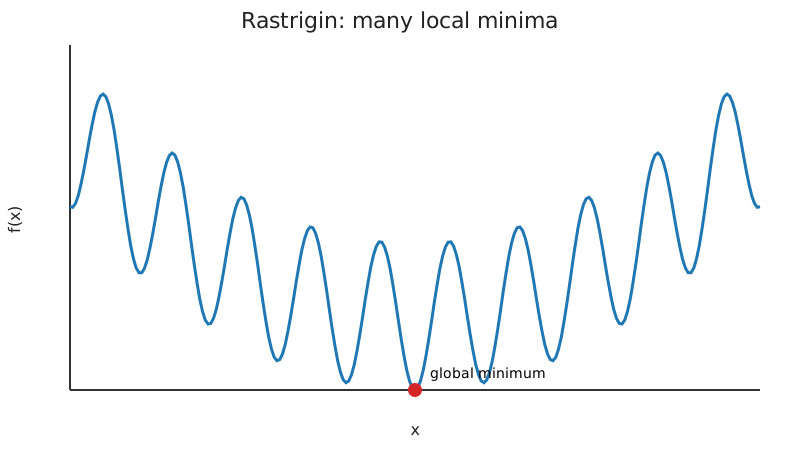
A local descent method started near $x=3$ can settle in a nearby basin instead of finding the origin.
Three strategies in the repository
The implementation includes:
- grid search: deterministic exhaustive sampling on a regular grid;
- simulated annealing: a stochastic trajectory that can accept uphill moves;
- genetic algorithm: a population-based evolutionary search.
Detailed notes:
Grid search and the curse of dimensionality
With $N$ points per coordinate in $n$ dimensions, a full Cartesian grid contains
$$ N^n $$
points. This makes exhaustive gridding useful for low-dimensional verification but rapidly impractical as $n$ grows.
If a one-dimensional interval has spacing $h$, the nearest grid point is at most $h/2$ away from the true minimizer. In multiple dimensions the geometric discretization error grows with the cell diagonal.
Turning grid spacing into an objective bound
On a full box grid with uniform coordinate spacing $h$, every point in the box is within Euclidean distance $\delta=h\sqrt n/2$ of a grid point, assuming the grid includes the box endpoints. If $f$ is $L$-Lipschitz and $f_{\mathrm{grid}}$ is the best sampled value, then
$$ f_{\mathrm{grid}}-L\delta\leq f^*\leq f_{\mathrm{grid}}. $$
The upper bound comes from an evaluated feasible point. For the lower bound, any point has a nearby grid value, and Lipschitz continuity limits how much lower its objective can be. Without a valid $L$, spacing controls distance but supplies no certified objective gap. Equality constraints or narrow feasible regions can also make a Cartesian grid miss all feasible points.
For the Rastrigin example, $f(x)=x^2+10[1-\cos(2\pi x)]\geq0$, and equality requires $x=0$. This proves the claimed global minimum analytically and supplies a benchmark against which a stochastic run can be checked. Generic black-box objectives rarely supply such a certificate.
Exploration versus exploitation
Global methods must balance two goals:
- exploration: sample regions not yet understood;
- exploitation: improve promising candidates.
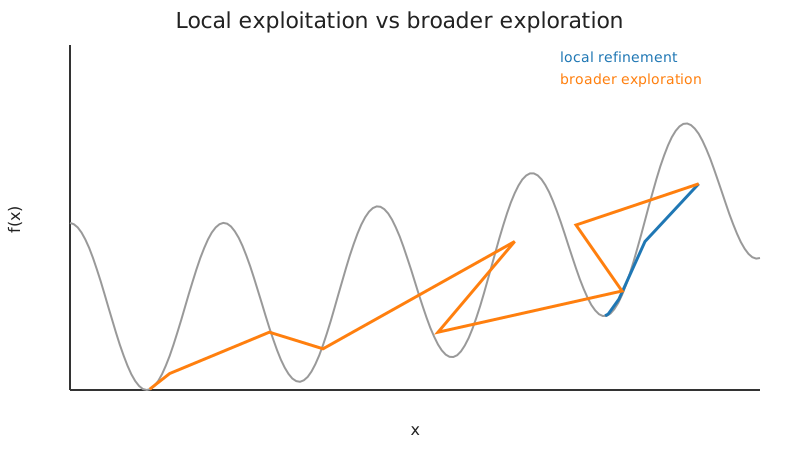
Too much exploitation causes premature convergence to a local minimum. Too much exploration wastes evaluations without refining good solutions.
Simulated annealing controls this balance through temperature. Genetic algorithms use selection pressure, crossover, mutation, and population diversity.
No free finite-time guarantee
For a generic black-box function, a finite number of samples cannot certify a true global optimum without additional assumptions. Strong guarantees require structure such as Lipschitz bounds, interval arithmetic, convexity, or exhaustive combinatorial reasoning.
This is why stochastic global methods usually report the best point found, not a mathematical proof of global optimality.
Hybrid strategies
One practical approach uses the following sequence:
- use a global method or multi-start sampling to locate promising basins;
- refine the best candidates with a fast local solver;
- compare final objective values and feasibility;
- repeat with different seeds when stochastic uncertainty matters.
This separates broad exploration from precise local convergence.
Repeated starts improve coverage only to the extent that the starting distribution reaches useful basins. If independent starts each have probability $q$ of reaching the target basin, then $m$ starts miss it with probability $(1-q)^m$. This explains the benefit of repetition under a fixed sampling model, but the unknown basin probability prevents the formula from serving as a generic global-optimality certificate.
Reproducibility
Stochastic optimization should expose and record random seeds. Report the number of function evaluations, not only iterations, because different algorithms can perform very different amounts of work per iteration.