Geometric Probability
Geometric probability describes random outcomes represented by locations, directions, lengths, or shapes. Under a uniform model, probability is proportional to the relevant geometric measure, such as length on a line or area in a plane. The sampling mechanism determines that measure: uniform angle, uniform radius, and uniform area are different models even when they generate points in the same disk.
For a region of finite positive measure sampled uniformly, divide the measure of the favorable subset by the measure of the whole region. If the density varies across the region, integrate that density instead. A larger area can then have less probability than a smaller area with higher density. State the uniformity assumption before using an area ratio.
Example 1: Distance from a Corner in a Square
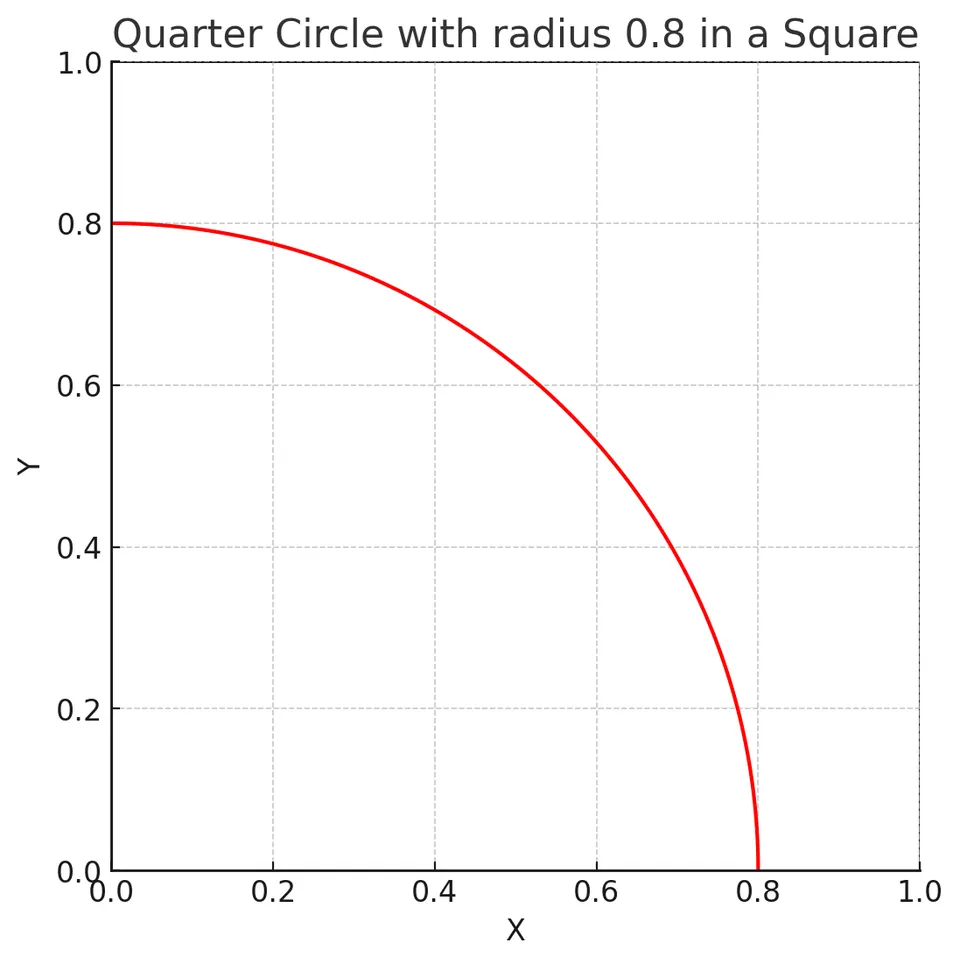
Calculate the probability that a randomly chosen point inside a unit square is at a distance less than $r$ units from a specific corner (the origin).
Setup:
- Consider a unit square in the first quadrant of the Cartesian coordinate system, with vertices at $(0,0)$, $(1,0)$, $(0,1)$, and $(1,1)$.
- Let $O$ denote the origin $(0,0)$.
- Let $D$ be the distance from a point $(X, Y)$ inside the square to $O$.
- We aim to find $P(D < r)$, the probability that $D < r$, where $0 \leq r \leq \sqrt{2}$ (for larger $r$ the probability is simply 1).
| Term | Description |
|---|---|
| Sample Space ($S$) | All points $(X, Y)$ such that $0 \leq X \leq 1$ and $0 \leq Y \leq 1$. |
| Event ($E$) | All points $(X, Y)$ such that $D = \sqrt{X^2 + Y^2} < r$. |
Since the points are uniformly distributed over the square, the probability density function (PDF) of $(X, Y)$ is constant over $S$:
$$f_{X,Y}(x, y) = \begin{cases} 1, & \text{if } (x, y) \in S, \\ 0, & \text{otherwise}. \end{cases}$$
Probability Calculation
The probability $P(D < r)$ is the ratio of the area of the region where $D < r$ (denoted as $A_E$) to the area of the square $A_S$:
$$P(D < r) = \frac{A_E}{A_S}.$$
Since $A_S = 1$ (unit square), $P(D < r) = A_E$.
Calculating $A_E$
The calculation of $A_E$ depends on the value of $r$:
| Case | Range |
|---|---|
| Case 1 | $0 \leq r \leq 1$ |
| Case 2 | $1 < r \leq \sqrt{2}$ |
| Case 3 | $r > \sqrt{2}$ |
Case 1: $0 \leq r \leq 1$
In this range, the quarter circle of radius $r$ lies entirely within the square.
Calculation
The area of a quarter circle of radius $r$ is:
$$A_E = \frac{\pi r^2}{4}.$$
Probability
$$P(D < r) = A_E = \frac{\pi r^2}{4}.$$
Example: For $r = 0.8$,
$$P(D < 0.8) = \frac{\pi (0.8)^2}{4} = \frac{\pi \times 0.64}{4} = 0.16\pi \approx 0.5027.$$
Case 2: $1 < r \leq \sqrt{2}$
In this range, the quarter circle extends beyond the square, and we need to calculate the portion of the circle that lies within the square.
Visual Representation
The overlapping area is the quarter circle minus the segments that lie outside the square (shaded regions beyond $x = 1$ and $y = 1$).
Calculation
I. Compute the area of the quarter circle:
$$A_{\text{quarter}} = \frac{\pi r^2}{4}.$$
II. Compute the area outside the square but inside the quarter circle:
Due to symmetry, calculate the area in one of the regions (e.g., where $x > 1$) and double it.
The two excluded pieces do not overlap when $r\leq\sqrt2$: having both $x>1$ and $y>1$ would require $x^2+y^2>2\geq r^2$. This justifies subtracting twice one piece without adding an overlap correction. At $r=1$, the second-case formula joins the quarter-circle area $\pi/4$; at $r=\sqrt2$, it gives one. These boundary checks help detect incorrect segment formulas.
$$A_{\text{outside}} = 2 \int_{x=1}^{r} \sqrt{r^2 - x^2} \, dx.$$
III. Compute the integral:
Perform a substitution $x = r \sin \theta$:
- $dx = r \cos \theta \, d\theta$.
- When $x = 1$, $\theta = \arcsin \left( \frac{1}{r} \right)$.
- When $x = r$, $\theta = \frac{\pi}{2}$.
The integral becomes:
$$\begin{aligned} A_{\text{outside}} &= 2 \int_{\theta_1}^{\frac{\pi}{2}} \sqrt{r^2 - r^2 \sin^2 \theta} \cdot r \cos \theta \, d\theta \\ &= 2 r^2 \int_{\theta_1}^{\frac{\pi}{2}} \cos^2 \theta \, d\theta \\ &= 2 r^2 \left[ \frac{\theta}{2} + \frac{\sin 2\theta}{4} \right]_{\theta_1}^{\frac{\pi}{2}} \\ &= 2 r^2 \left( \frac{\pi}{4} - \frac{\theta_1}{2} - \frac{\sin 2\theta_1}{4} \right). \end{aligned}$$
IV. Compute $A_E$:
$$\begin{aligned} A_E &= A_{\text{quarter}} - A_{\text{outside}} \\ &= \frac{\pi r^2}{4} - 2 r^2 \left( \frac{\pi}{4} - \frac{\theta_1}{2} - \frac{\sin 2\theta_1}{4} \right) \\ &= \frac{\pi r^2}{4} - r^2 \left( \frac{\pi}{2} - \theta_1 - \frac{\sin 2\theta_1}{2} \right) \\ &= r^2 \left( \theta_1 + \frac{\sin 2\theta_1}{2} - \frac{\pi}{4} \right). \end{aligned}$$
V. Simplify using trigonometric identities:
$$ \theta_1 = \arcsin \left( \frac{1}{r} \right) $$
$$ \sin 2\theta_1 = 2 \sin \theta_1 \cos \theta_1 = 2 \cdot \frac{1}{r} \cdot \sqrt{1 - \left( \frac{1}{r} \right)^2} = \frac{2 \sqrt{r^2 - 1}}{r^2} $$
VI. Final Expression for $A_E$:
$$A_E = r^2 \left( \arcsin \left( \frac{1}{r} \right) + \frac{\sqrt{r^2 - 1}}{r^2} - \frac{\pi}{4} \right).$$
Probability
$$P(D < r) = A_E = r^2 \left( \arcsin \left( \frac{1}{r} \right) + \frac{\sqrt{r^2 - 1}}{r^2} - \frac{\pi}{4} \right).$$
Example: For $r = 1.2$,
I. Compute $\arcsin \left( \frac{1}{1.2} \right)$:
$$\arcsin \left( \frac{1}{1.2} \right) \approx \arcsin(0.8333) \approx 0.9851.$$
II. Compute $\sqrt{(1.2)^2 - 1}$:
$$\sqrt{1.44 - 1} = \sqrt{0.44} \approx 0.6633.$$
III. Compute $A_E$:
$$\begin{aligned} A_E &\approx (1.2)^2 \left( 0.9851 + \frac{0.6633}{(1.2)^2} - \frac{\pi}{4} \right) \\ &= 1.44 \left( 0.9851 + \frac{0.6633}{1.44} - 0.7854 \right) \\ &= 1.44 \left( 0.9851 + 0.4606 - 0.7854 \right) \\ &= 1.44 \times 0.6603 \approx 0.9509. \end{aligned}$$
So, $P(D < 1.2) \approx 95.1\%$.
Case 3: $r > \sqrt{2}$
For $r > \sqrt{2}$, the entire square lies within the circle of radius $r$ centered at the origin. Thus, every point in the square satisfies $D < r$.
Probability
$$P(D < r) = 1.$$
Example 2: Probability of a Random Chord in a Circle Being Longer Than the Radius
Calculate the probability that a randomly drawn chord in a circle is longer than the radius of the circle.
Setup:
- Consider a circle with radius $R$ centered at the origin $(0, 0)$.
- A chord is drawn at random within the circle.
- We aim to find $P(L > R)$, the probability that the length $L$ of the chord exceeds $R$.
Understanding the Problem
The problem is known as Bertrand's Paradox, which arises because the probability depends on how "at random" is defined when selecting chords in a circle. There are multiple methods to select a chord at random:
| Method | Description |
|---|---|
| Random Endpoints Method | Choose two independent uniform random points on the circumference and draw the chord between them. |
| Random Radial Point Method | Choose a radius at random, choose a point uniformly along it, and draw the chord perpendicular to the radius through that point. |
| Random Midpoint Method | Choose a point uniformly at random inside the disk as the midpoint of the chord. |
Each method is well defined, but they yield different probabilities for $P(L > R)$: $\frac{2}{3}$ for random endpoints, $\frac{\sqrt{3}}{2}\approx 0.866$ for the random radial point, and $\frac{3}{4}$ for the random midpoint. Which one is "correct" depends on the physical mechanism that is meant by "at random". We'll use the Random Midpoint Method for this example.
| Term | Description |
|---|---|
| Sample Space ($S$) | All points $(X, Y)$ inside the circle $x^2 + y^2 \leq R^2$, representing possible midpoints of chords. |
| Event ($E$) | All midpoints $(X, Y)$ such that the corresponding chord has length $L > R$. |
Relation Between Midpoint and Chord Length
A chord's length $L$ is related to its distance $d$ from the center of the circle:
$$L = 2 \sqrt{R^2 - d^2}.$$
For the chord to have $L > R$:
$$2 \sqrt{R^2 - d^2} > R \implies \sqrt{R^2 - d^2} > \frac{R}{2} \implies R^2 - d^2 > \left( \frac{R}{2} \right)^2 \implies d^2 < \left( \frac{R\sqrt{3}}{2} \right)^2.$$
Thus, the event $E$ corresponds to all midpoints within a circle of radius $\frac{R\sqrt{3}}{2}$ centered at the origin.
Probability Calculation
I. Area of the Inner Circle ($A_E$):
$$A_E = \pi \left( \frac{R\sqrt{3}}{2} \right)^2 = \pi \left( \frac{R^2 \times 3}{4} \right) = \frac{3\pi R^2}{4}.$$
II. Area of the Entire Circle ($A_S$):
$$A_S = \pi R^2.$$
III. Probability:
$$P(L > R) = \frac{A_E}{A_S} = \frac{\frac{3\pi R^2}{4}}{\pi R^2} = \frac{3}{4}.$$
Therefore, the probability that a randomly drawn chord (using the Random Midpoint Method) is longer than the radius of the circle is $\frac{3}{4}$ or 75%.
For uniform midpoint area, the distance $D$ of the midpoint from the center has CDF $P(D\leq d)=d^2/R^2$ and density $2d/R^2$ on $[0,R]$. A thin ring farther from the center has more area, so its radius is more likely. The random-radial-point method instead makes $D$ uniform on $[0,R]$, producing $P(D<\sqrt3R/2)=\sqrt3/2$.
For random endpoints, the smaller angle $\Theta$ between them is uniform on $[0,\pi]$ and $L=2R\sin(\Theta/2)$. The condition $L>R$ becomes $\Theta>\pi/3$, whose probability is $2/3$. These derivations show that the disagreement comes from different probability laws, not inconsistent rules. The familiar classical Bertrand problem often uses the side length of an inscribed equilateral triangle as its threshold; this example uses the radius, so its numerical probabilities differ from those commonly quoted for that threshold.
Example 3: Probability That the Sum of Two Random Numbers Is Less Than 1
Calculate the probability that the sum of two independent random numbers $X$ and $Y$, each uniformly distributed between 0 and 1, is less than 1.
Setup:
- Random variables $X$ and $Y$ are independent and uniformly distributed on the interval [0, 1].
- We aim to find $P(X + Y < 1)$.
Mathematical Formulation
Joint Probability Density Function
Since $X$ and $Y$ are independent and uniformly distributed, their joint PDF is:
$$f_{X,Y}(x, y) = \begin{cases} 1, & \text{if } 0 \leq x \leq 1, \, 0 \leq y \leq 1, \\ 0, & \text{otherwise}. \end{cases}$$
| Term | Description |
|---|---|
| Sample Space ($S$) | The unit square in the $xy$-plane where $0 \leq x \leq 1$ and $0 \leq y \leq 1$. |
| Event ($E$) | The set of points where $x + y < 1$. |
Probability Calculation
The probability $P(X + Y < 1)$ is the area under the joint PDF over the region $E$:
$$P(X + Y < 1) = \iint_E f_{X,Y}(x, y) \, dx \, dy = \iint_E 1 \, dx \, dy = \text{Area of } E.$$
Geometric Interpretation
The region $E$ is a right triangle within the unit square bounded by $x = 0$, $y = 0$, and $x + y = 1$.
Calculating the Area
I. Set Up the Integral:
$$P(X + Y < 1) = \int_{x=0}^{1} \int_{y=0}^{1 - x} dy \, dx.$$
II. Evaluate the Inner Integral:
$$\int_{y=0}^{1 - x} dy = (1 - x) - 0 = 1 - x.$$
III. Evaluate the Outer Integral:
$$P(X + Y < 1) = \int_{x=0}^{1} (1 - x) \, dx.$$
IV. Compute the Integral:
$$P(X + Y < 1) = \int_{x=0}^{1} (1 - x)dx$$
$$= \left[ x - \frac{x^2}{2} \right]_{0}^{1} $$
$$= \left( 1 - \frac{1}{2} \right) - \left( 0 - 0 \right) = \frac{1}{2} $$
Therefore, the probability that the sum of two independent uniform random variables on [0, 1] is less than 1 is $\frac{1}{2}$ or 50%.
The line $x+y=1$ has area zero, so replacing the strict inequality by $X+Y\leq1$ leaves the probability unchanged in this continuous model. The transformation $(x,y)\mapsto(1-x,1-y)$ also maps the below-line triangle to the above-line triangle and preserves uniform area. This symmetry provides an independent check of the integral.