Gamma Distribution
The gamma family models positive quantities with flexible right-skewed shapes. Write $X\sim\mathrm{Gamma}(\alpha,\beta)$, where $\alpha>0$ is the shape and $\beta>0$ is the rate. This note uses a rate, not a scale; the corresponding scale is $\theta=1/\beta$.
For an integer shape $\alpha=k$, one construction is a sum of $k$ independent exponential waits with rate $\beta$. It is therefore the wait to the $k$-th event of a constant-rate Poisson process, also called an Erlang distribution. Noninteger shapes define valid gamma distributions too, but do not literally count a fractional number of events.
Density and shape
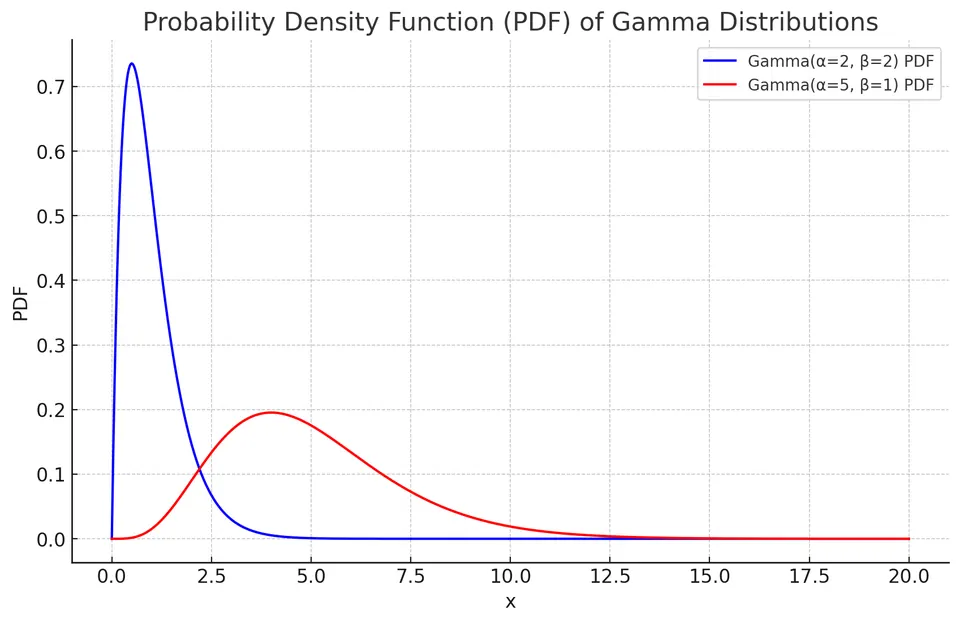
The density is
$$ f(x;\alpha,\beta)=\frac{\beta^\alpha}{\Gamma(\alpha)}x^{\alpha-1}e^{-\beta x}, \qquad x>0. $$
It is zero for negative $x$. The gamma function normalizes the shape:
$$ \Gamma(\alpha)=\int_0^\infty u^{\alpha-1}e^{-u}\,du. $$
Substituting $u=\beta x$ verifies that the density integrates to 1. When $\alpha=1$, the power of $x$ disappears and the model reduces to an exponential distribution. Shapes above 1 have an interior peak; shapes below 1 concentrate density near zero. A high or unbounded density there does not assign positive probability to the exact value zero.
Cumulative distribution function
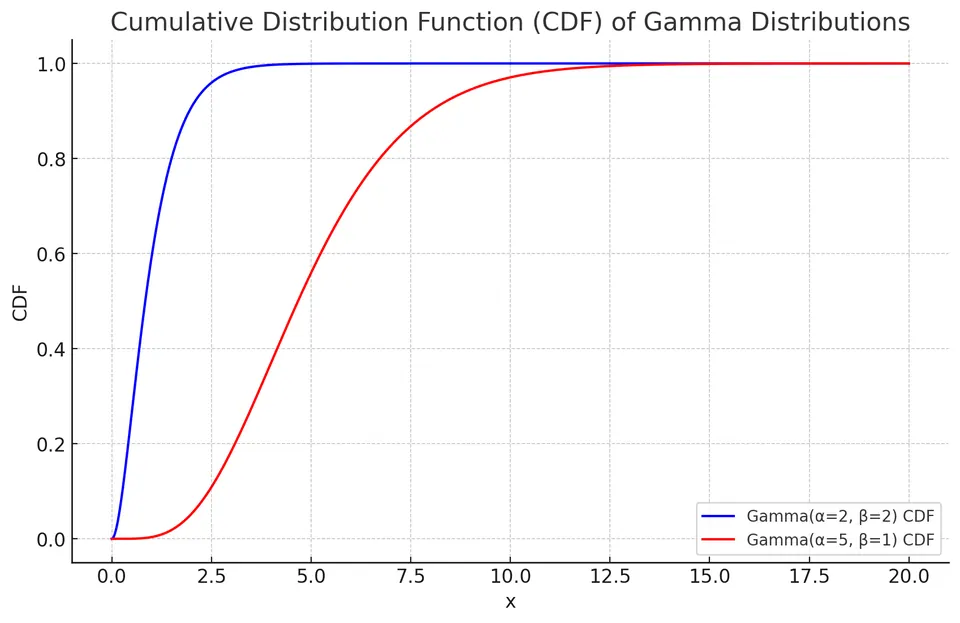
The CDF is
$$ F(x;\alpha,\beta)=\frac{1}{\Gamma(\alpha)} \int_0^{\beta x}u^{\alpha-1}e^{-u}\,du,\qquad x\ge0. $$
Below zero it is zero. The general expression uses the regularized incomplete gamma function; it is not simply the density evaluated at the threshold. Integer shapes have a finite-sum expression:
$$ F(x;k,\beta)=1-e^{-\beta x}\sum_{j=0}^{k-1}\frac{(\beta x)^j}{j!}. $$
The complement says that waiting beyond $x$ means fewer than $k$ Poisson events have arrived by $x$.
Mean, variance, and MGF
With an integer shape, adding the independent exponential means and variances gives $k/\beta$ and $k/\beta^2$. The same moment formulas hold for every positive real shape:
$$ E[X]=\frac{\alpha}{\beta},\qquad \mathrm{Var}(X)=\frac{\alpha}{\beta^2}. $$
For a fixed shape, doubling the rate halves the mean and divides the variance by four. This is why substituting a scale for a rate changes the answer substantially.
Multiplying the density by $e^{tx}$ replaces its exponential decay rate $\beta$ with $\beta-t$. Comparing the resulting integral with the gamma normalization gives
$$ M_X(t)=\left(1-\frac{t}{\beta}\right)^{-\alpha},\qquad t<\beta. $$
Differentiation at zero recovers the mean. The second raw moment is $\alpha(\alpha+1)/\beta^2$; subtracting the squared mean recovers the variance. In software using scale, set scale = 1 / beta while keeping the same shape.
Example: modeled intervals between floods
Suppose a hydrologist models positive flood intervals in years by a gamma distribution with shape $\alpha=2$ and rate $\beta=1/3$ per year. This is an assumed interval distribution, not a consequence of knowing the average interval alone.
Average interval
$$ E[X]=\frac{2}{1/3}=6\text{ years}. $$
Variance of the interval
$$ \mathrm{Var}(X)=\frac{2}{(1/3)^2}=18\text{ years}^2. $$
The standard deviation is $\sqrt{18}\approx4.24$ years. The squared units distinguish variance from an ordinary time interval.
For this integer shape, $F(x)=1-e^{-x/3}(1+x/3)$. At the mean of 6 years it gives $F(6)=1-3e^{-2}\approx0.5940$, illustrating that the mean is not generally the median of a skewed distribution.
If the flood arrivals themselves formed a constant-rate Poisson process, ordinary consecutive-event waits would be exponential. The integer-shape gamma construction instead describes a wait across several such events. A gamma model for single flood intervals therefore needs its own empirical or physical justification.
Applications
Gamma models are used for positive waiting times, accumulated durations, hydrological quantities, and some survival or financial-duration models. Their usefulness depends on the shape and mechanism of the quantity studied; positivity alone does not select a gamma family over other positive distributions.
Practice: Exercises with worked solutions